
Jean Tinkler
Turning complexity into navigable learning journeys.
How I work
I work at the intersection of learning design, technology, and organisational reality, helping teams move from ambiguous learning requests to clear, deliverable solutions that hold up under real-world constraints.
How I approach learning problems
Learning problems rarely arrive neatly defined. I begin by clarifying what's actually being asked, who the learning is for, and the constraints shaping the situation — including time, capability, systems, and stakeholder expectations.
From there, I design learning solutions that are proportionate to the problem, deliberately sequenced, and aligned to both learner needs and organisational context.
How I work with others
I work closely with clients, SMEs, developers, and delivery partners, translating learning intent into formats that different roles can work with confidently.
I place a strong emphasis on early alignment, shared understanding, and making assumptions and trade-offs explicit.
This approach supports smoother collaboration, reduces rework, and helps teams progress with greater clarity and trust throughout the lifecycle of a project.
How I balance rigour and pragmatism
I value evidence-based learning design and strong andragogical foundations, while remaining conscious of delivery realities.
My aim is to design solutions that are rigorous without being over-engineered, and that can be realistically built, maintained, and evolved over time.
Where constraints exist, I work within them transparently — adjusting scope, modality, or sequencing to protect learning outcomes rather than forcing idealised designs.
What clients and teams can expect
Clients and teams can expect clear communication, considered judgement, and a collaborative working style. I bring structure where it's needed, flexibility where it's helpful, and a steady focus on designing learning solutions that are effective, defensible, and fit for purpose.
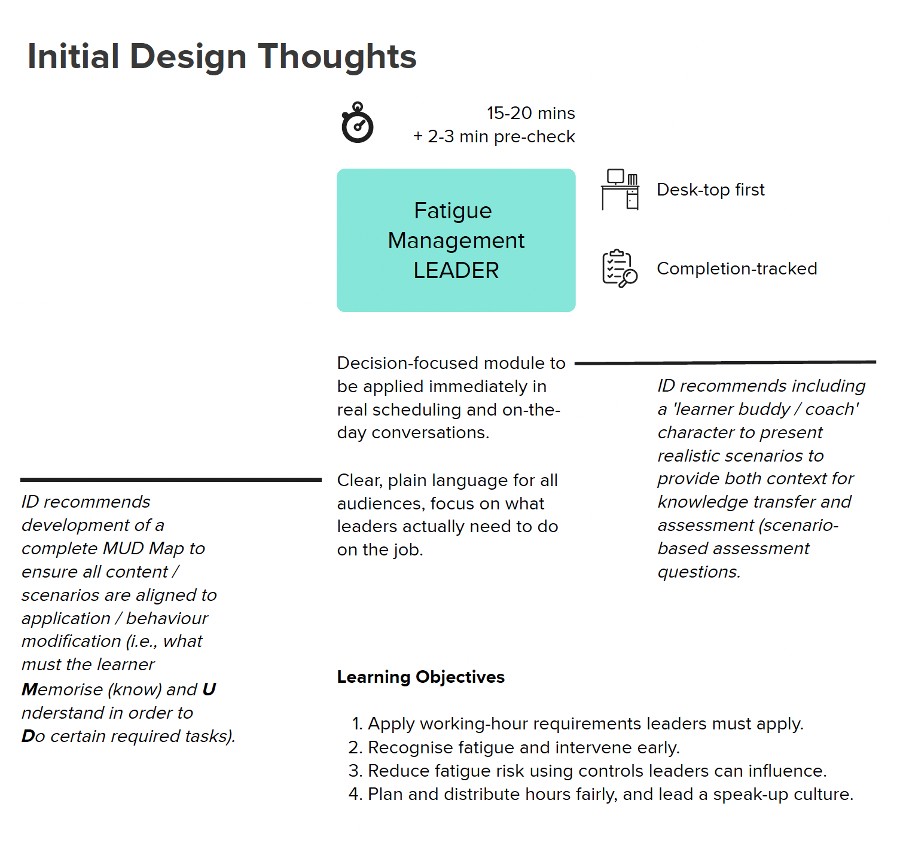
Example: Initial design thoughts
Core Capabilities
Critical and Systems Thinking
Applies systems-led judgement to ill-defined learning problems, clarifying constraints, testing assumptions, and making practical, defensible decisions with downstream impact in mind.
What this looks like in practice
Many learning challenges are presented as content problems, when they're actually system problems.
My approach is to step back, clarify what's really going on, and design learning solutions that hold up under real-world pressure — not just in theory.
Digital Fluency
Digitally fluent across modern learning ecosystems, with strong judgement in selecting, integrating, and governing tools to balance learner experience, accessibility, scalability, and delivery constraints.
What this looks like in practice
Digital fluency, for me, is less about knowing individual tools and more about understanding how learning technologies work together within a system. I focus on selecting and combining platforms based on learning intent, audience needs, accessibility considerations, and delivery constraints — not novelty.
In practice, this means designing learning solutions that are sustainable to build, easy to maintain, and appropriate for the context they’ll be delivered in. I’m comfortable working across platforms and modalities, and I use emerging tools — including AI — to support quality, efficiency, and iteration while maintaining strong professional judgement.
Evidence: Platform and AI-informed design choice (Rise course)
Cross-Functional Problem-Solving
Resolves cross-functional challenges by aligning learning design, development, and stakeholder expectations early — reducing rework, friction, and delivery risk.
What this looks like in practice
Cross-functional problem-solving in my work centres on reducing friction before it becomes visible delivery risk. I spend time early clarifying roles, constraints, and assumptions across designers, developers, SMEs, and stakeholders — particularly where expectations or mental models differ.
In practice, this means translating learning intent into formats that different disciplines can work with, anticipating handover points, and making trade-offs explicit so decisions are shared rather than escalated later. The result is smoother collaboration, fewer late-stage surprises, and learning solutions that hold together across design and delivery.